
Download App
Bridge Navigation & Deck Operations

ECDIS - General Knowledge

In this test, you will assess your knowledge of ECDIS technical requirements and IMO standards, rules for operating Electronic Navigation Charts (ENCs), official Admiralty publications and their application in navigation, as well as working with system sensors and interfaces.

Questions 15
Time Limit 9 min
Language English

Sample Questions

Here are some example questions from this quiz. Download the GYRO app to take the full test.

Question 1
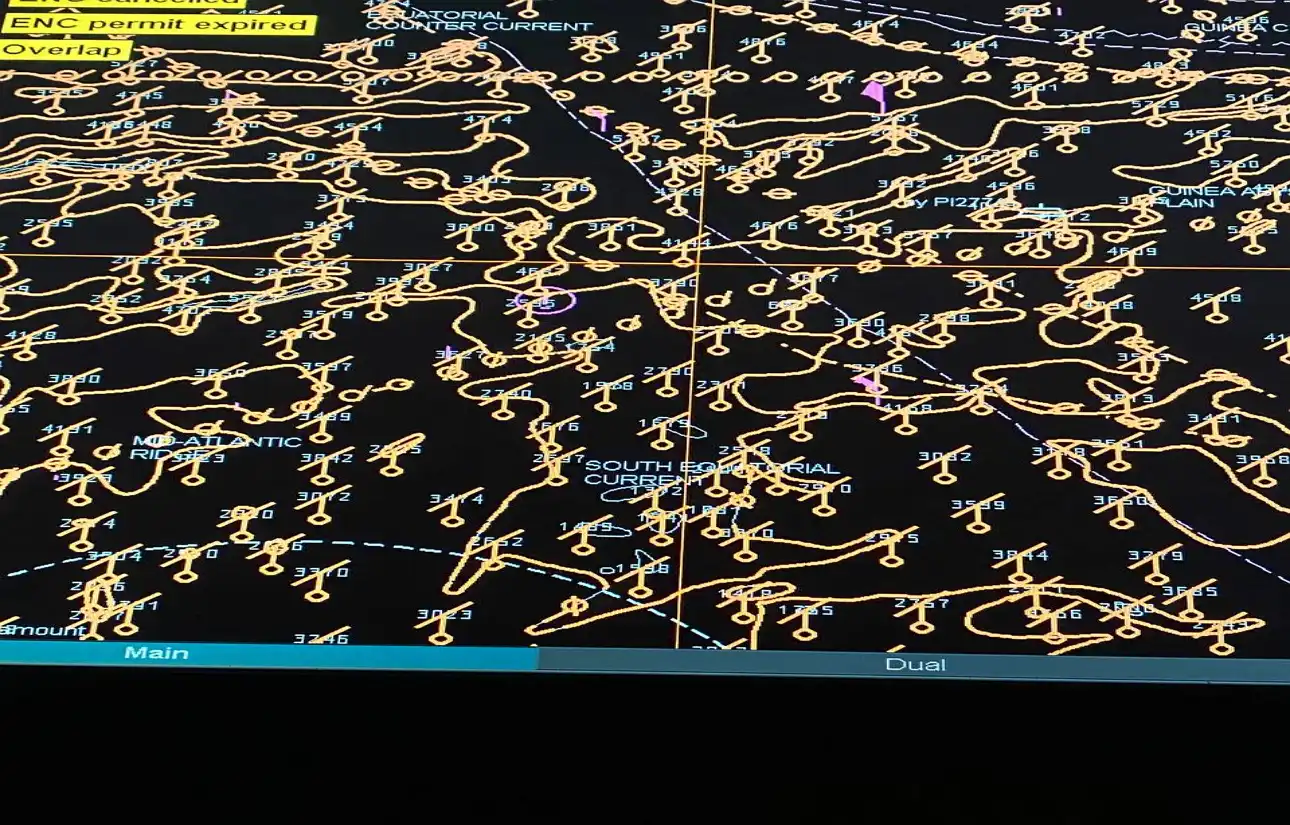
How do you disable the ocean current display on ECDIS?

A Use the "Alarms & Warnings" tab to turn off navigation alerts.
B Go to the chart display settings, navigate to Layers/Overlay, and deactivate Ocean Currents or GRIB option.
C Select the Vector Chart Only mode under the Base Display menu.
D Zoom out the chart below the Coastal scale level.

Question 2

What properties of raster charts are correct?

A An exact digital copy of paper charts.
B Scaling the chart results in a change in the visible size of topographic objects on the display.
C Require a large amount of disk space.
D All information is directly applied to the raster chart.
E Corrections cannot be applied.

Question 3

A format for recording and storing graphical images as matrices of points (pixels) is

A Raster format.
B Vector format.
C ENC data representation format.

Question 4

The statement that if radar marks and their corresponding ENC objects match, the position of your ship determined by the primary EPFS (GPS) is considered reliable and:

A Сorrect, provided that the radar mark is reliably identified with the corresponding chart object.
B Сorrect.
C Incorrect.

Question 5

Pick the correct definition of Warning.
A Conditions that require immediate attention to inform the bridge team of non-hazardous conditions that may become dangerous.
B Awareness of a condition which still requires attention out of the ordinary consideration of the situation or of given information.
C Conditions or situations which require immediate action to avoid immediate danger, to make the bridge team aware of conditions which are immediately hazardous.
D Alert type which can be skipped.